
New pours, replacements and widening
Concrete Driveways in Goodyear, AZ
Sized for what you actually park, thick enough for the weight, and sloped so storm water leaves the garage alone.
- Free site visit: we measure, check grade and look at where storm water runs
- Itemized written price covering thickness, steel, base, finish and sealing
- Summer pours booked for early morning, with a written cure plan
Driveways Built for How West Valley Families Park
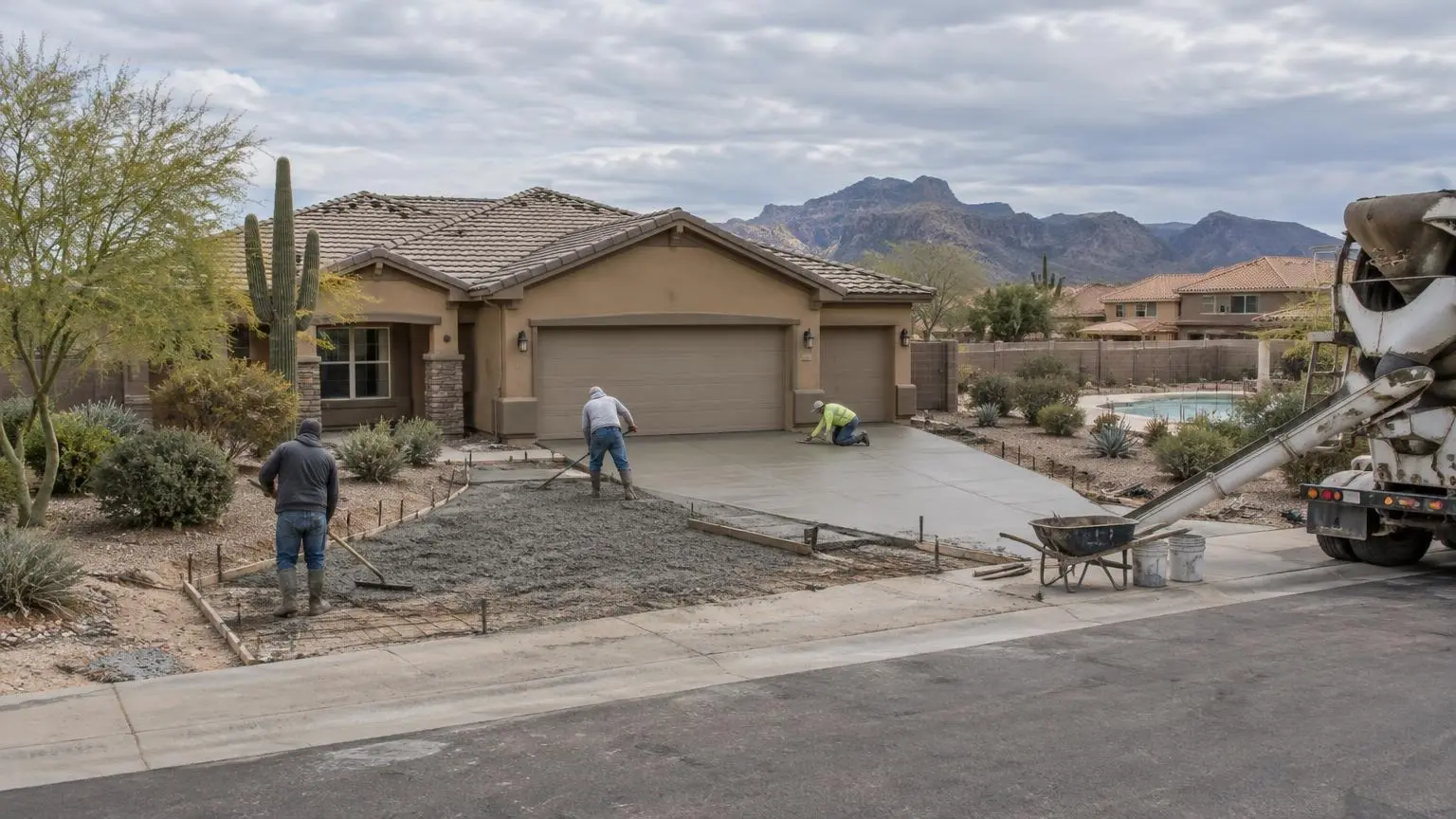
Concrete driveways in Goodyear often carry more than the builder planned. A house that came with room for two cars may now hold three, plus a work truck, a utility trailer or a boat. Many of those slabs are also getting old: Point2Homes, working from Census data, puts the median Goodyear home at 2007. We pour new driveways, replace failing ones and add width or side parking, so extra vehicles stop living on gravel or at the curb.
Widening, RV parking or a full replacement
Adding width. A strip goes along one or both sides of the current slab. We either drill and set dowels into the old edge or separate the two with an isolation joint, so the old and new concrete can move without snapping the seam.
Parking for an RV or boat. This usually means a pad beside the garage or back through a side gate. It gets more thickness and more steel than a car driveway, and before we price it we measure the gate opening, the turning path and your HOA's rules on where an RV may sit.
Starting over. When the slab has wide cracks, dropped panels or a crumbling apron, we break it out, haul it off, repair the subgrade and pour new.
The layers below the surface
Most driveway failures start underneath. We excavate old material and soft fill, then compact the subgrade. Some West Valley lots have caliche, a hard calcium carbonate layer that Wikipedia says can range from inches to feet thick and can keep water from draining; where we hit it, we chip down high spots so the base is an even depth. A layer of crushed rock is compacted on top. Four inches of concrete is the norm for passenger vehicles, and HomeGuide calls for 6 inches under heavy vehicles, which is what we suggest for RV, boat and work-truck parking.
Reinforcement, joints and fall
Steel does not stop concrete from cracking, but it holds any crack tightly closed. HomeGuide prices rebar at $1 to $3 a square foot. Control joints decide where cracks will form; a common rule for a 4-inch slab is a joint roughly every 8 to 12 feet, laid out so panels stay close to square. The surface falls toward the street so monsoon water does not run toward the garage door. The apron where your driveway meets the street can fall under right-of-way rules, so we look into that before work begins.
When a driveway is ready to be replaced
- Cracks wider than roughly 1/4 inch, or edges where one side sits higher
- Panels that have sunk and hold puddles after a storm
- An apron broken at the garage or at the curb
- Flaking, exposed stone, or a patchwork of past repairs
- Not enough width for the vehicles in the household
If the damage is confined to a panel or two, replacing just those panels may be all you need.
Surface options under the Arizona sun
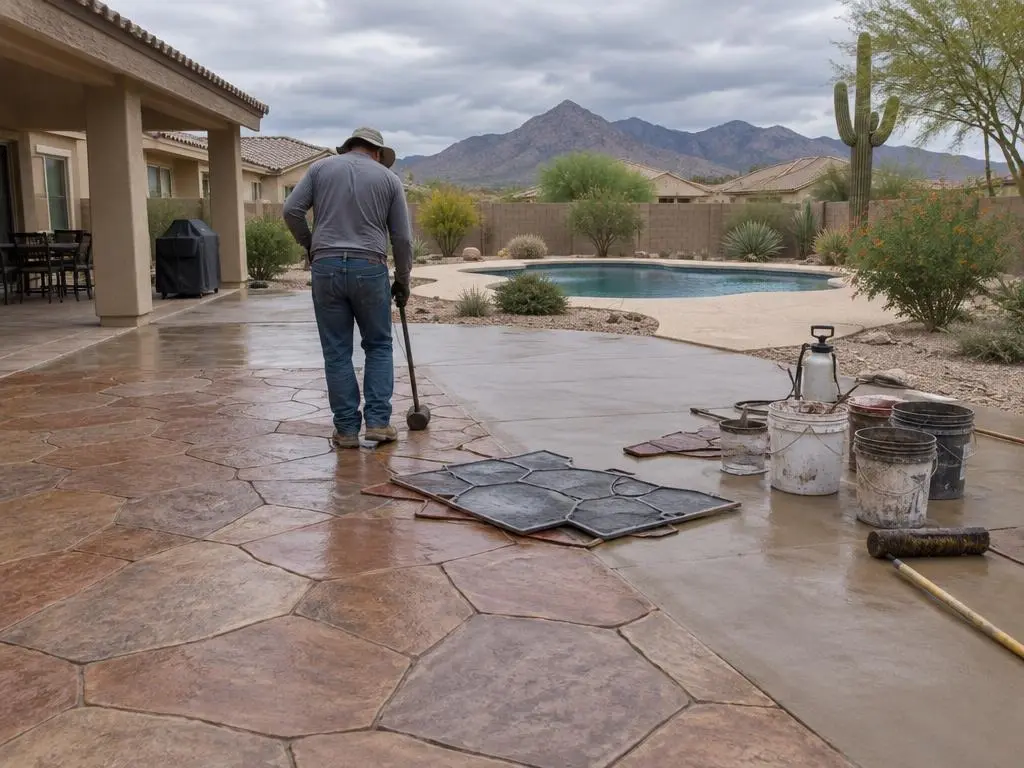
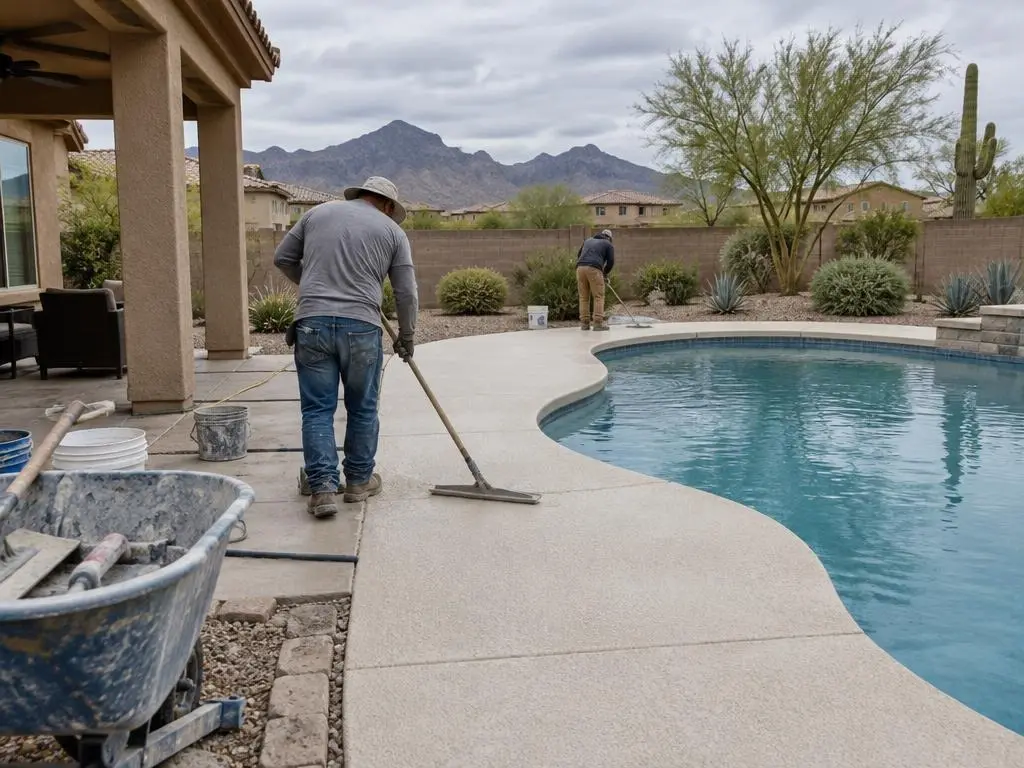
Broom texture is the default for good reason: its fine ridges give tires and shoes traction, even wet. Exposed aggregate disguises dust and tire marks. A stamped border, or a fully stamped driveway, adds pattern and color, but HomeGuide's figures put stamped driveways well above plain ones. Light tones stay cooler than dark ones. A sealer applied every couple of years helps keep oil from soaking in and slows fading.
The first month after the pour
In hot months we place driveway concrete soon after sunrise and start curing the moment finishing is done. HomeGuide's timeline is 24 to 48 hours before walking on it, at least 7 days before a car, and 28 to 30 days before heavy vehicles. Keep sprinklers from wetting the new concrete for the first few days, and keep tires off the edges early on, because a young slab is weakest at its edges.
What Goes Into a Driveway Quote
Your written price breaks the work into these pieces, which makes bids easier to compare.
Demolition and hauling
Breaking up the existing driveway, apron or side strip and taking the rubble off site.
Subgrade and base rock
Excavating to an even depth, clearing soft material and compacting crushed rock.
Steel
A rebar grid or wire mesh, with dowels wherever new concrete meets a slab that stays.
Placing and finishing
Pouring, screeding and finishing in broom, exposed aggregate or a stamped band.
Joints and cure
Control joints cut on the planned layout and curing started immediately after finishing.
Side and RV pads
Heavier, reinforced pads beside the garage or behind a gate for boats, trailers and RVs.
Typical Concrete Driveway Costs
| Item | Published range |
|---|---|
| Installed, standard finish (per sq ft) | $6 to $10 |
| One-car, 12' x 24' (288 sq ft) | $1,700 to $4,300 |
| Two-car, 24' x 24' (576 sq ft) | $3,500 to $8,600 |
| Three-car, 24' x 36' (864 sq ft) | $5,200 to $13,000 |
| 6-inch slab for heavy vehicles (per sq ft) | $8 to $20 |
| Rebar reinforcement (per sq ft) | $1 to $3 |
| Old driveway removal (per sq ft) | $2 to $6 |
National ranges from HomeGuide's concrete driveway cost guide. Goodyear prices depend on access, tear-out, thickness, finish and what we find under the old slab. Your written estimate is the price.
Driveway Steps, Start to Finish
1. Site visit
We measure, lay out the shape, check fall to the street and ask what you park and where.
2. Removal and base
Old concrete is broken out, the area is dug to depth and crushed rock is compacted.
3. Forming and steel
Forms are set to slope, reinforcement is placed and dowels are drilled into any slab that remains.
4. Pour and cure
Concrete goes in early, gets its finish, joints are cut and curing begins that morning.
Concrete Driveways Questions
What thickness does a driveway need?
For cars and SUVs, 4 inches over compacted base rock is typical. HomeGuide recommends 6 inches for heavy vehicles such as RVs, trailered boats and loaded work trucks, and those pads usually get heavier steel too.
Can my driveway be widened rather than replaced?
If the current slab is solid, usually yes. We saw a straight edge, add dowels or an isolation joint, and pour the new strip at the same slope. Fresh concrete will look lighter than the old slab at first, and we can show you ways to blend the two.
Is a permit needed for driveway work in Goodyear?
Goodyear's homeowner permit FAQ includes a front-yard concrete slab or driveway among the projects that need a permit. We confirm the requirement for your job, and most HOAs want to approve the plan as well.
What lifespan should I expect?
HomeGuide estimates 30 to 40 years for a concrete driveway that gets basic care. A well-compacted base, sensible joint spacing, water kept away from the edges and periodic sealing all push toward the long end.
Is cracking normal?
A certain amount, yes, since concrete shrinks as it hardens. Joints steer that shrinkage into neat lines and steel keeps stray cracks closed. Wide cracks or ones with a height difference are not normal and usually point to the base.
Concrete Driveways Service Areas
- Concrete Contractors in Goodyear, AZ
- Concrete Contractors in Estrella, AZ
- Concrete Contractors in Avondale, AZ
- Concrete Contractors in Litchfield Park, AZ
- Concrete Contractors in Buckeye, AZ
- Concrete Contractors in Verrado, AZ
- Concrete Contractors in Tolleson, AZ
- Concrete Contractors in Citrus Park, AZ
- Concrete Contractors in Glendale, AZ
- Concrete Contractors in Arrowhead Ranch, AZ
- Concrete Contractors in Peoria, AZ
- Concrete Contractors in Surprise, AZ
- Concrete Contractors in El Mirage, AZ
- Concrete Contractors in Youngtown, AZ
- Concrete Contractors in Sun City, AZ
- Concrete Contractors in Sun City West, AZ
- Concrete Contractors in Waddell, AZ
- Concrete Contractors in Laveen, AZ
- Concrete Contractors in Maryvale, AZ
- Concrete Contractors in Rainbow Valley, AZ
Get a Concrete Driveways Estimate
Free on-site estimates for new, replacement and wider driveways in Goodyear and nearby West Valley towns.